
 简体中文
简体中文 Русский
 Français
 Português
 Español
 لالعربية
.jpg "Practical-deployment-tips for BYD lithium-ion forklifts within factories with limited-charging-station-space(figure1)")
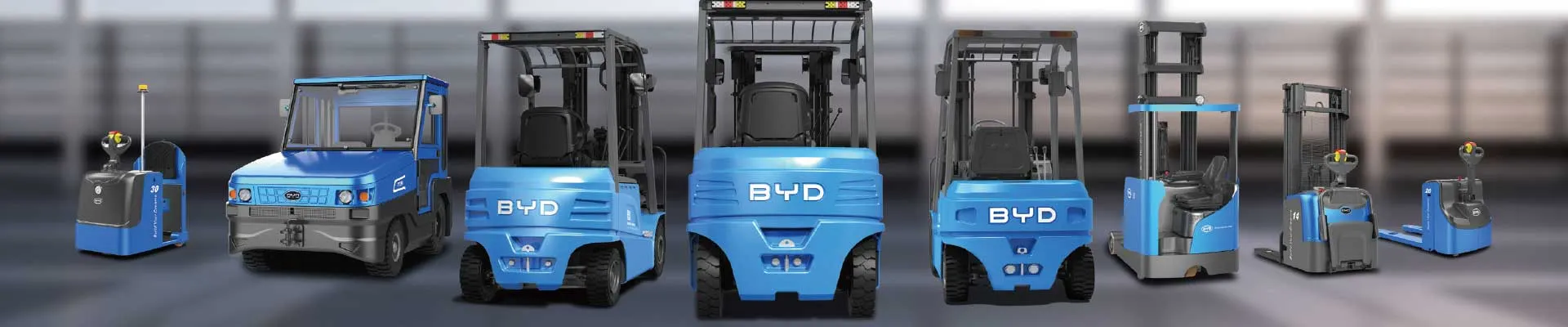
As a veteran practitioner with years of in-depth exploration in the electric forklift industry, we sort out systematic, practical operational and maintenance guidelines for frontline warehouse operators and logistics managers, to help users fully grasp the core points of using electric forklift correctly.
Core Pre-operation Check Protocols
Before each formal use of electric forklift, operators need to complete a set of standardized inspection work to avoid potential hidden risks in subsequent operations. First, confirm the remaining power level of the power system, check that the tire surface has no obvious foreign matter embedding and abnormal wear, test the flexibility and stability of the braking system and steering mechanism, and simply verify the up and down operation of the hydraulic lifting part, to ensure all basic components are in normal standby state.
Standard In-operation Safety Rules
During the operation process, operators should strictly follow the load capacity label specified on the equipment body, and do not attempt to carry over-weighted goods for a long time. When driving on wet, uneven or narrow passage sections, appropriately reduce the driving speed, and keep a safe distance from surrounding shelves, personnel and other operation equipment. It is not recommended to carry out sharp steering operation at high speed, and do not extend any part of the body outside the guard frame of the vehicle during the whole operation process.
Cost-effective Routine Maintenance Methods
Carrying out daily simple maintenance work can effectively extend the overall service life of the electric forklift and reduce the frequency of unexpected faults. Operators can regularly clean the dust accumulation at the heat dissipation opening of the drive motor and electrical control box, check whether the surface of the connecting cable has cracks or exposed inner cores, apply a small amount of professional lubricant to the hinge parts of the gantry regularly, and keep the battery at 40% to 80% power level when the equipment is left unused for a long period.
Scenario-based Performance Optimization Tips
For different types of warehouse operation scenarios, users can adjust the operation mode of the equipment appropriately to get better use effect. In narrow passage operation scenarios, users can activate the corresponding low-speed steering mode to improve the operation precision, and for the high-frequency continuous cargo handling scenario, reasonably arrange the operation shift schedule to avoid long-time continuous overload of the power system. These verified operation points can effectively help the logistics team reduce unnecessary operation cost, improve the smoothness of daily material handling, and create higher practical value for the whole warehouse operation system.


