
 简体中文
简体中文 Русский
 Français
 Português
 Español
 لالعربية
.jpg "BYD-forklift-local-technical-support-resource-check-list-for-prospective-international-buyers(figure1)")
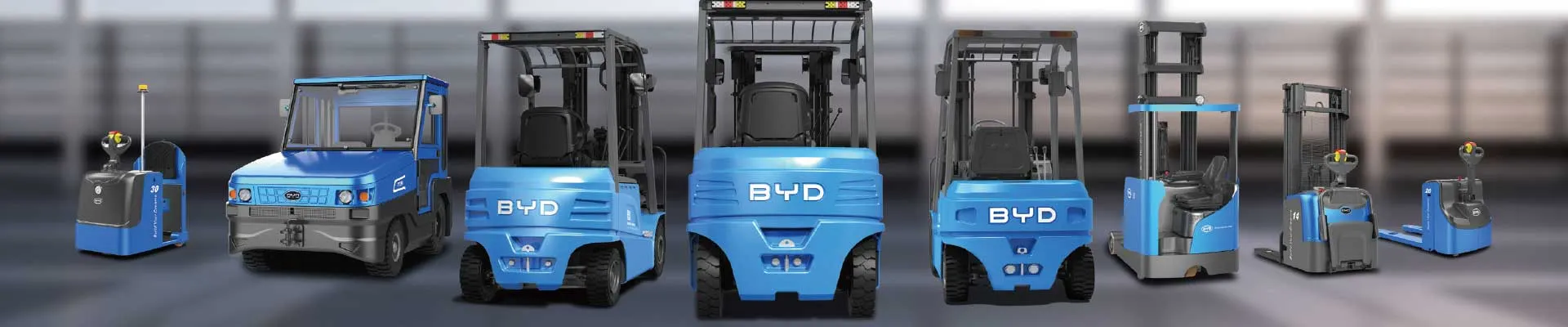
Against the continuous upgrading of global warehouse logistics systems, electric forklift has become one of the most widely applied material handling equipment in various industrial scenarios, thanks to its low noise emission, zero on-site pollution and relatively flexible operating performance. Many frontline operators and warehouse managers still lack systematic understanding of correct usage and maintenance rules, which may cause extra equipment loss and hidden safety risks in daily operations.
Core Daily Operation Specifications
When operators start the equipment, they need to check the surrounding working area first to confirm no irrelevant personnel or obstacles stay within the moving range, avoid sudden acceleration or sharp turning during the moving process, and keep the load center within the allowable range marked on the equipment specification. It is not recommended to operate the equipment on slopes with gradient beyond the specified parameter, nor to carry out overload lifting operations for a long time, which will produce extra burden on the power system and hydraulic structure. Operators should also avoid prolonged continuous operation under high temperature or heavy dust environment, and arrange proper rest period for the equipment according to the actual working intensity.
Routine Maintenance Guidelines
For daily post-shift maintenance, operators should wipe the surface of equipment body to remove accumulated dust and sundries on the moving parts, check the battery connection status and remaining power level, and arrange timely charging to avoid deep power loss that will affect the overall battery performance in the long run. Professional maintenance personnel should conduct regular inspection on the hydraulic oil status, brake sensitivity and tire wear degree, replace the aging consumable parts in time according to the actual wear situation, and record all maintenance data to form a complete equipment operation file. This set of standardized maintenance process can effectively reduce the occurrence of sudden equipment failure in peak operation periods.
Scenario-based Efficiency Improvement Tips
For different application scenarios, operators can adjust the operation mode reasonably to match the actual working demand. In narrow aisle warehouse scenarios, operators can control the moving speed at a relatively low level to guarantee operation accuracy and safety, while in wide flat cargo yard scenarios, they can adjust the operation parameters to a proper range to improve material transferring efficiency. It is also feasible to arrange proper staff scheduling to avoid long-time overworking of a single operator, so as to keep the operation accuracy at a stable level for the whole working shift.


