
 简体中文
简体中文 Русский
 Français
 Português
 Español
 لالعربية
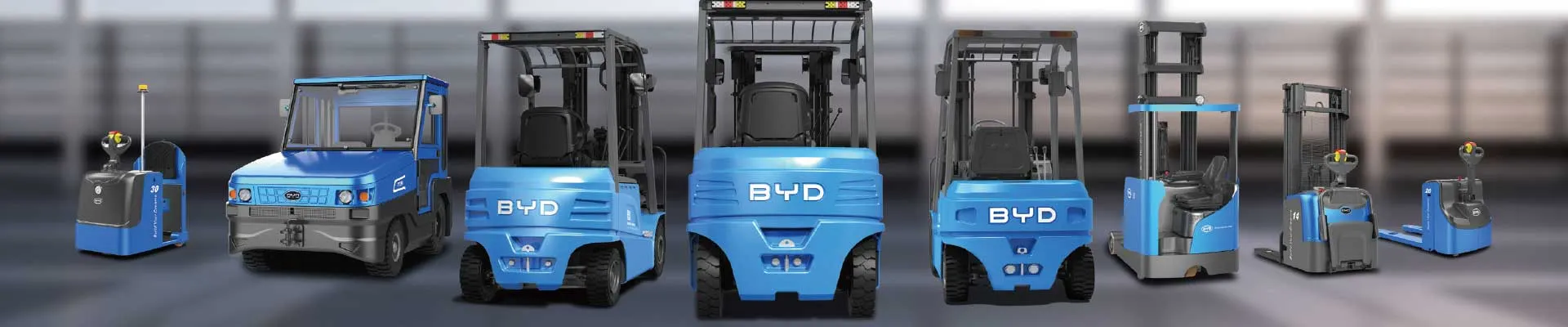
.jpg "- BYD Forklifts in the USA: Dealers, Pricing, and Local Support(figure1)")
With the continuous popularization of new energy material handling equipment in logistics, manufacturing and warehousing scenarios, electric forklifts have become one of the most widely used equipment for short-distance cargo handling and stacking. Many operators and equipment managers still lack systematic, practical professional knowledge to maximize the value of this type of equipment in daily work.
Core Performance Characteristics of Electric Forklifts
Different from internal combustion handling equipment, electric forklifts rely on power battery packs to provide power output, with no tail gas emission, relatively low operation noise, and more stable torque output at low speed. Most products of this type are suitable for closed or semi-closed operation scenarios such as indoor warehouses, cold storage, and finished product workshops, and will not cause adverse impact on the ambient air quality. The overall weight distribution of the whole vehicle is more reasonable after optimized design, which can balance the load force effectively during cargo picking and placing operation, and adapt to the operation requirements of most conventional material handling scenarios.
Standardized Daily Operation Requirements
Before starting the equipment every day, operators need to check the remaining power level of the battery pack, the flexibility of the lifting hydraulic system, the braking sensitivity and the integrity of the warning light components, and confirm that there is no abnormal obstacle in the surrounding operation route. During the driving process, the operating speed should be adjusted according to the ground condition, cargo weight and on-site personnel flow density, avoid sudden acceleration or emergency braking under heavy load state. When the lifting height of the fork exceeds a certain range, the driving speed should be controlled at a low level to prevent the center of gravity of the whole vehicle from shifting. Operators need to keep the body in a standard sitting posture, and do not extend any part of the body out of the protection frame of the vehicle during the whole operation.
Routine Maintenance Suggestions
After each daily use, operators should park the equipment in the designated charging area, wipe the dust and debris on the surface of the vehicle and the gap of the ventilation heat dissipation components, and connect the power supply for charging according to the standard process. The battery pack should avoid long-term full load storage or complete power loss state, and the regular depth discharge detection and maintenance can be arranged according to the actual use frequency. For the hydraulic oil in the lifting system, the wear condition of the tire and the fastening degree of the connecting parts, the special management personnel can arrange regular inspection every fixed cycle, replace the aging consumable parts in time, and reduce the occurrence probability of sudden equipment failure. Good operation habits can effectively prolong the service life of the whole equipment, and create more stable value for daily material handling work.


