
 简体中文
简体中文 Русский
 Français
 Português
 Español
 لالعربية
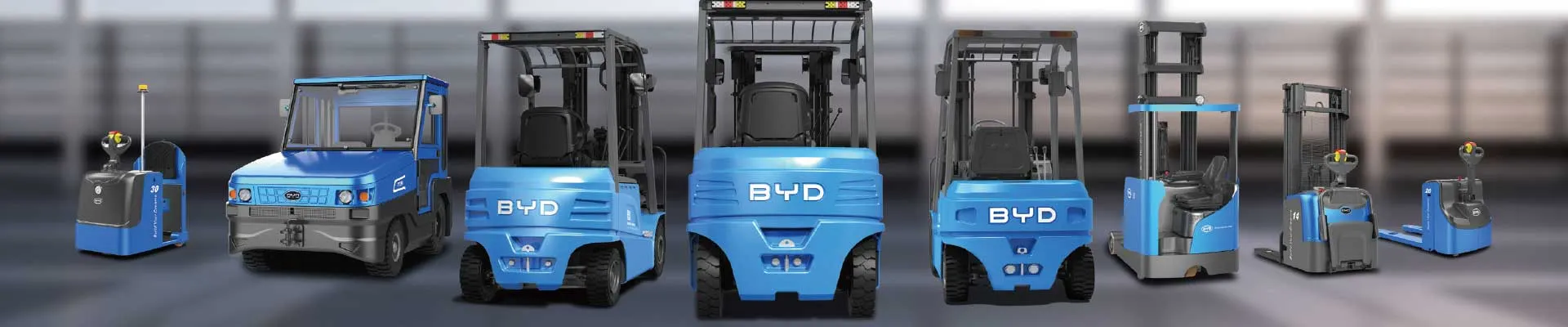
.jpg "- BYD Forklifts: How an EV Maker Entered Material Handling(figure1)")
Against the background of accelerating low-carbon transformation in the global industrial sector, electric forklifts have gradually become one of the most widely used material handling equipment in closed operation scenarios such as urban warehouses, production workshops and cold chain storage in recent years. Different from traditional internal combustion handling equipment, electric forklifts rely on electric energy as the core power source, and their performance is closely related to operation habits and daily maintenance levels, which directly affects the overall efficiency of logistics links.
Core Functional Advantages of Electric Forklifts
Most electric forklift models operate with a noise level lower than that of traditional fuel counterparts, which can avoid noise disturbance to on-site operators in enclosed spaces and reduce the probability of hearing-related occupational health risks in long-term high-intensity operation scenarios. As no exhaust gas is generated during the operation process, it can also meet the environmental control requirements of special scenarios such as food storage, pharmaceutical production workshops, which have strict restrictions on exhaust emissions. The compact body design of most common electric forklifts also allows flexible passage in narrow channel spaces, maximizing the utilization rate of warehouse storage space.
Standard Operation Specifications for Electric Forklifts
Before each formal operation, operators need to complete a full pre-inspection work, including checking the remaining power level of the power system, the flexibility of the braking and steering components, and the smooth lifting state of the fork loading structure, to eliminate hidden risks in the bud. During the operation process, operators need to follow the load parameter range marked on the equipment nameplate, avoid long-time overload operation that may cause damage to the motor and hydraulic structure, slow down when turning and passing through crowded areas, and remind surrounding personnel to avoid through prompt devices. After the daily operation is completed, the operator should park the equipment in the designated area, lower the fork to a horizontal position close to the ground, and cut off the main power supply of the equipment.
Practical Daily Maintenance Suggestions for Electric Forklifts
The power energy storage component is the core part of the electric forklift that needs regular maintenance. Operators should regularly check the tightness of the connecting line of the energy storage component and the surface cleaning state, avoid liquid entering the electrical connection area and cause short circuit risks. The dust accumulated in the heat dissipation gap of the driving motor should be cleaned regularly to ensure that the heat generated during high-intensity operation can be discharged smoothly. When the equipment is in long-term idle state, the staff should arrange regular supplementary power inspection according to the product manual requirements, to avoid the performance attenuation of the energy storage component caused by long-term power loss. Scientific and standardized maintenance can effectively extend the service life of the equipment, and optimize the overall operating cost of the logistics handling link.


