
 简体中文
简体中文 Русский
 Français
 Português
 Español
 لالعربية
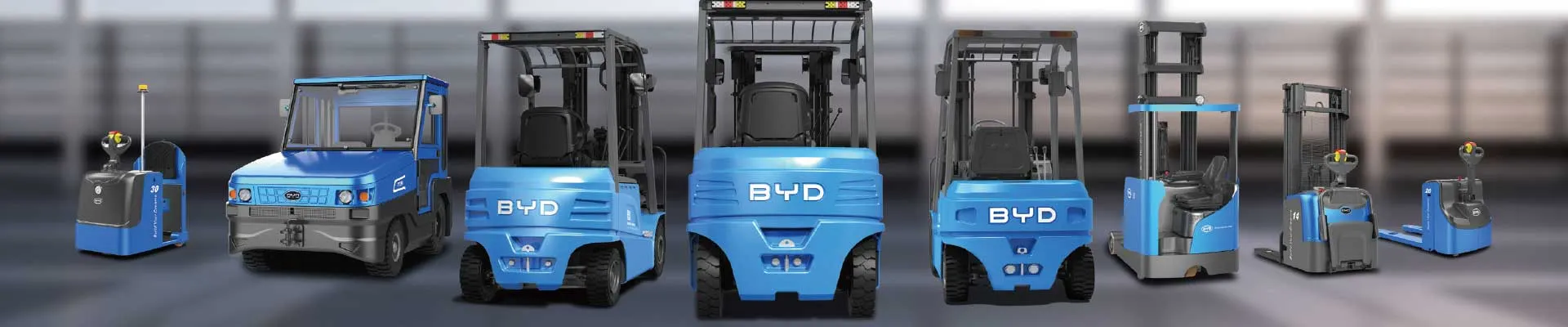
.jpg "BYD electric pallet jack maintenance-suggestions for warehouse-on-site-maintenance-teams-reference(figure1)")
Against the backdrop of global industrial low-carbon transformation, electric forklifts have emerged as a widely accepted material handling solution for closed indoor operation sites, bringing more feasible optimization options for daily warehousing and logistics work.
Core Functional Advantages of Electric Forklifts
Compared with traditional fuel-powered handling equipment, electric forklifts produce no exhaust emission on the operation site, and the overall operating noise is kept at a relatively low level, which effectively improves the working environment for on-site staff in confined warehouse spaces. Most standard electric forklift models have compact body structure and small turning radius, which can flexibly pass through narrow warehouse aisles to complete goods stacking, high-low position transferring and short-distance cargo moving tasks. The operation control system of such equipment is designed with higher response sensitivity, which reduces the learning threshold for new operators to get familiar with standard operation workflows.
Routine Operation and Maintenance Guidelines
Before each shift of operation, operators need to complete necessary pre-inspection work, including checking the remaining battery level, testing the response sensitivity of the braking system, and confirming the lubrication status of the lifting transmission components. It is not recommended to run the equipment under full load continuously for a time period exceeding the official specified safe duration, and regular dust-proof and moisture-proof treatment for circuit connection ports can effectively reduce the probability of unexpected equipment failures. Following standardized maintenance procedures can extend the service cycle of electric forklifts to a large extent, and cut down the extra cost caused by unplanned downtime.
Scenario Matching and Efficiency Optimization Tips
Different operation scenarios can select electric forklifts with matching parameter configurations according to actual demand. For low-temperature high-altitude working areas, configurations with adapted battery management systems are more suitable to ensure stable power output. For high-frequency heavy-load operation sites, enterprises can arrange reasonable battery charging or replacing scheduling plans according to the actual daily operation volume, to avoid unexpected power shortage that affects the whole work progress. Proper application of electric forklift systems can help warehousing operators steadily improve overall material turnover efficiency, and realize reasonable control of long-term comprehensive operating costs.


