
 简体中文
简体中文 Русский
 Français
 Português
 Español
 لالعربية
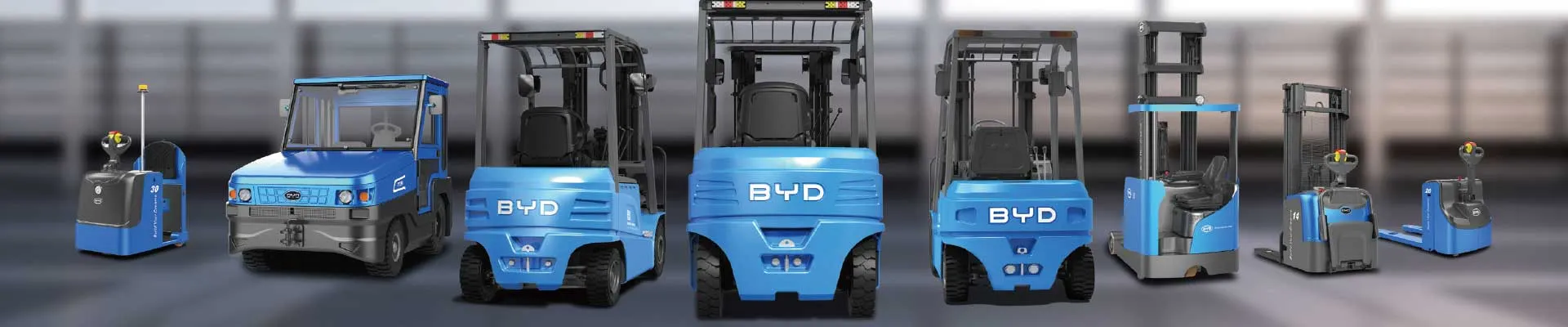
.jpg "BYD Forklift Lineup Overview: Models for Every Job(figure1)")
Against the backdrop of growing low-carbon demand in industrial logistics, electric forklifts have become one of the most widely applied material handling tools in various warehouse and industrial scenarios in recent years. Compared with traditional fuel-powered counterparts, they bring distinct improvements in operation experience and environmental friendliness for daily material transportation work.
Core Operational Advantages of Electric Forklifts
Electric forklifts produce no exhaust emission during the whole operation process, which makes them fully suitable for enclosed indoor spaces that have strict requirements for air quality. Their overall operation noise is kept at a relatively low level, which will not cause excessive noise interference for surrounding staff or affect the normal operation of other supporting equipment in the work area. The electric drive structure also provides more stable output power, and the control sensitivity of the steering and speed adjustment system is friendly for operators of different skill levels, which can effectively reduce the misoperation rate in daily handling tasks.
Daily Maintenance Essentials for Extended Service Cycle
Reasonable daily maintenance work can effectively prolong the service life of electric forklifts and reduce unexpected downtime in peak operation periods. Operators need to check the battery status regularly, keep the charging port clean and avoid liquid or debris entering the interface to cause poor contact. It is also necessary to check the wear degree of the brake assembly and the sealing performance of the hydraulic pipeline at fixed intervals, and timely handle minor abnormal conditions found in the inspection process. Operators should also follow the rated load standard in the operation process, avoid long-term overloading that may cause extra loss of the drive system and load-bearing structure.
Scenario Adaptation Tips for Different Usage Demands
For different actual application scenarios, users can adjust the matching scheme and operation mode of electric forklifts according to their own demand characteristics. For narrow-channel shelf warehouses, users can select models with smaller turning radius to improve the utilization rate of storage space. For low-temperature cold chain storage scenarios, users can adopt batteries with low-temperature adaptation performance to ensure stable power output in low-temperature environment. For scenarios that require continuous high-intensity operation for a long time, users can arrange standby batteries for cyclic replacement to avoid operation interruption caused by power exhaustion.


