
 简体中文
简体中文 Русский
 Français
 Português
 Español
 لالعربية
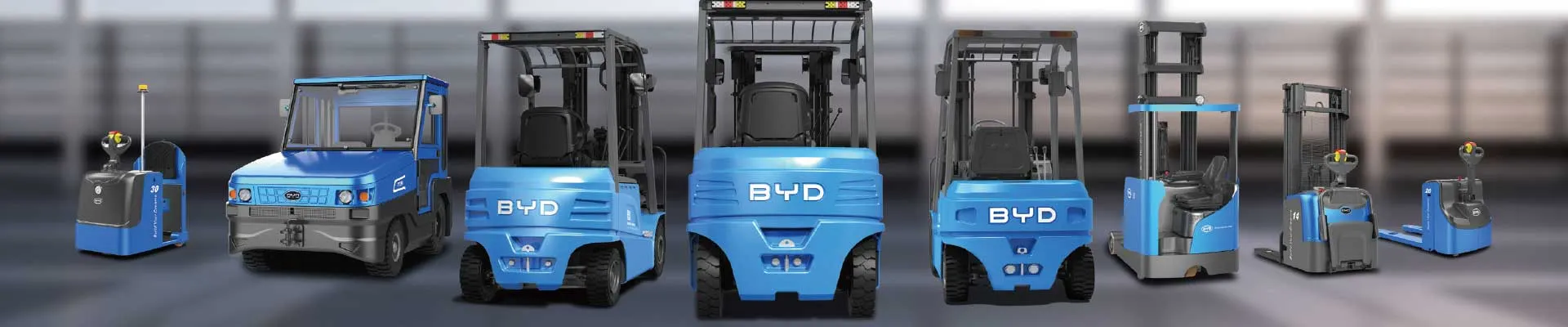
.jpg "- How BYD Forklifts Compare with Established Global Brands(figure1)")
Against the background of accelerating low-carbon transformation in the industrial logistics sector, electric forklifts have gradually become one of the core equipment for indoor and closed-site material handling due to their low noise, zero local emissions and relatively friendly operating experience. Most front-line operators and warehouse managers can master more systematic, scenario-matched operation and management skills through standardized professional guidance, to give full play to the inherent advantages of such equipment.
Core Operating Best Practices for Daily Use
Before each startup, operators need to conduct a quick visual check of the surrounding working area to confirm no scattered obstacles, unrelated personnel or hidden sundries on the driving route. It is not recommended to carry out sudden acceleration or sharp steering actions in the initial stage of operation, especially when the equipment is in a fully loaded state. When the forklift is running on wet, slippery or uneven ground, the driving speed should be appropriately reduced to keep the vehicle body stable. During the cargo lifting process, keep the mast slightly tilted backward to ensure the goods are firmly placed on the pallet, and avoid dragging the goods on the ground to cause extra load loss. Operators also need to avoid using the braking system for long-time deceleration in the process of downhill, to prevent excessive wear of the brake components.
Targeted Regular Maintenance to Extend Service Life
Routine maintenance work can be arranged according to the actual working frequency and environment of the equipment. The energy storage component is the core part of the electric forklift, and staff need to check the electrolyte level regularly for lead-acid models, and avoid the phenomenon of over-discharge that the remaining power is lower than the standard warning line. The charging area should be kept well ventilated, and no flammable materials are allowed to be stacked around. In the daily inspection process, workers also need to check the wear degree of the solid tires, confirm no hidden leakage points in the hydraulic oil pipeline, clean up the accumulated dust on the surface of the heat dissipation channel, and test the sensitivity of the braking and steering system regularly. These small inspection steps can effectively reduce the probability of sudden equipment failure in peak working hours.
Scenario-Based Performance Adjustment for Different Workloads
For different warehouse operation scenarios, operators can make reasonable adjustments to the equipment's operating parameters within the allowable range of the specification. For narrow aisle working scenarios, the maximum driving speed can be limited to a lower level to reduce the collision risk with surrounding shelves. For high-strength continuous operation scenarios with frequent loading and unloading of heavy goods, the lifting speed of the fork can be appropriately reduced to keep the equipment running stably, and a reasonable rest interval can be reserved for the equipment to dissipate heat after 2 to 3 hours of continuous full-load operation. These targeted adjustment measures can make the equipment performance more matched with the actual working conditions, and avoid unnecessary energy consumption loss.
Basic Safety Compliance Notes for Daily Operation
All operators need to receive complete professional training before taking up the post, and be familiar with the specific parameter range of the equipment they operate. Do not exceed the rated load limit to lift goods, and do not use the forks to lift personnel to carry out high-altitude operations without supporting auxiliary tools. When the operator needs to leave the working position, he should pull the handbrake completely, lower the forks to the ground, and cut off the main power supply of the equipment. When the forklift is parked on the ramp, it is not allowed to carry goods for a long time to stay, to avoid the risk of accidental slipping of the vehicle body. Following these basic operation norms can help the electric forklift maintain a good working state for a long time, and provide stable support for the daily operation of the warehouse logistics system.


