
 简体中文
简体中文 Русский
 Français
 Português
 Español
 لالعربية
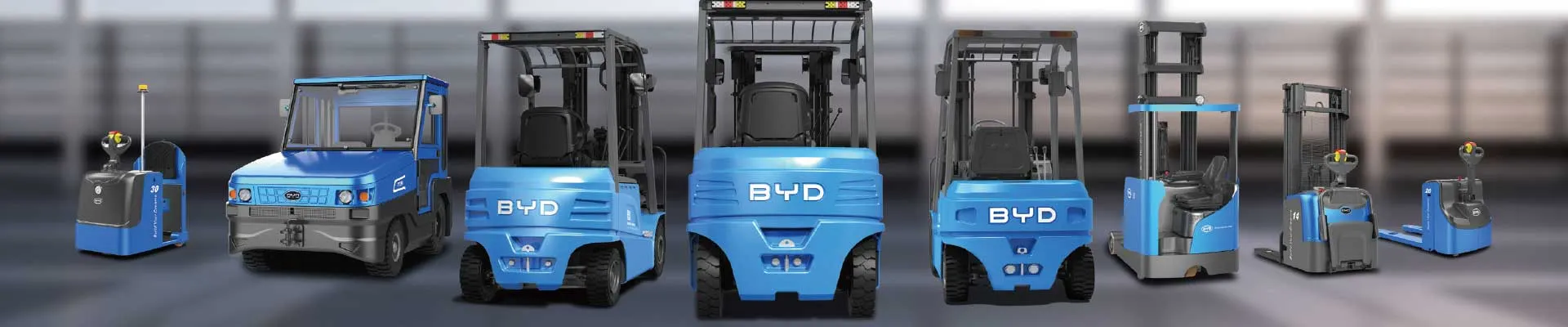
.jpg "Considerations for mixed-fleet deployment combining BYD lithium-ion forklifts with existing-warehouse-equipment(figure1)")
Many warehouse operators choose to introduce new lithium-ion forklifts as incremental capacity instead of full fleet replacement in a short period, to balance cost budget and operation efficiency upgrade. The mixed deployment of new BYD lithium-ion forklifts and existing warehouse equipment can deliver stable performance improvement only when proper pre-planning and dynamic adjustment are implemented in the whole process.
First of all, complete pre-deployment compatibility assessment before putting new forklifts into actual operation. Operation teams need to verify the matching degree between new forklift parameters and existing warehouse facility conditions, including turning radius matching with preset passage width, load capacity alignment with existing pallet and cargo handling standards, and power supply load test at designated charging areas to make sure the existing power grid can support the normal charging demand of new lithium-ion devices without extra hidden risks. The team also needs to mark adjusted operation routes on the warehouse site according to the performance characteristics of new forklifts, to avoid cross interference between different types of equipment in the same work zone.
Secondly, build aligned operation specifications for the whole mixed fleet. Provide unified systematic training for all on-site operators, which retains the mature operation rules for existing original equipment, and supplements core operation points for new lithium-ion forklifts, including daily pre-shift inspection of battery status, safe operation rules for opportunity charging, and proper response to common minor alarms. The operation scheduling team can make full use of the zero-emission, fast-response characteristics of new lithium-ion forklifts, arrange them to take charge of peak period high-frequency handling tasks, and coordinate with existing equipment to form a more flexible capacity allocation mechanism, to reduce waiting time for cargo handling.
Thirdly, establish a unified operation and maintenance management system for all equipment in the mixed fleet. Incorporate the new lithium-ion forklifts into the original equipment management ledger, record their regular maintenance cycle, battery health status tracking points, and spare parts inventory requirements in a unified standard, to avoid management loopholes caused by separated management of new and old equipment. Arrange regular joint patrols for all operating devices, to timely detect and solve abnormal wear or hidden failures on any equipment, and keep the whole fleet running in stable condition.
At the final stage, carry out phased operation data tracking and optimization. Collect operation data of the mixed fleet in the first 2 to 3 months after deployment, including single shift handling volume, average energy consumption, equipment utilization rate, to adjust the scheduling logic and operation flow gradually without large-scale transformation of existing mature warehouse processes. This gradual transition mode can effectively reduce operation trial and error cost, help the warehouse obtain stable efficiency improvement at controllable input.


